
AI Investment and Energy: Follow the Costs and Cash Flow
Rising AI demand can lead very different businesses to be labelled “AI stocks.” Chip sellers, data-center builders, and electricity buyers earn and spend differently. Trace the money before turning a power-demand forecast into a company earnings forecast.
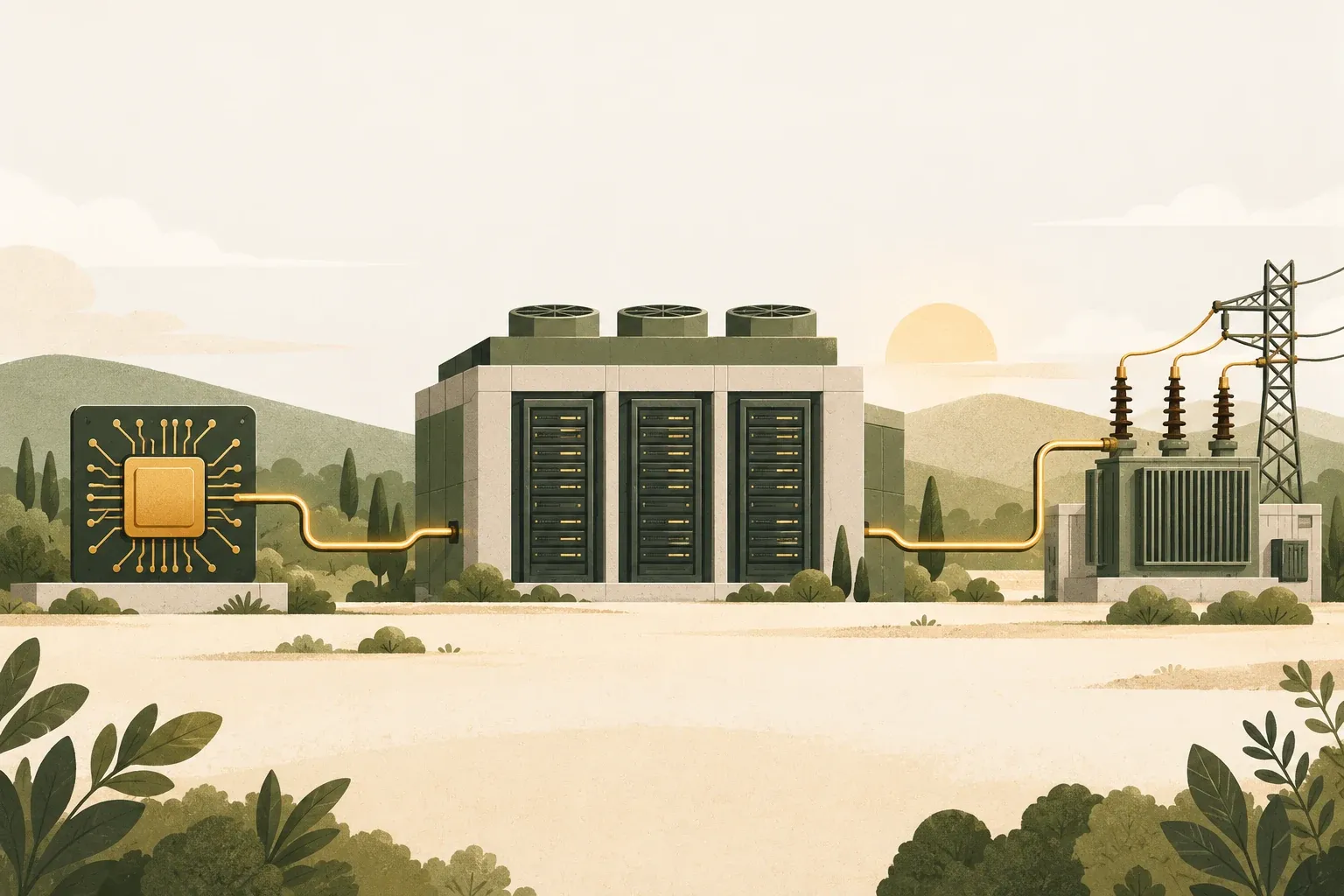
Start with money flows instead of labeling every company an AI stock
An AI service needs chips, memory, networks, servers, buildings, power, and cooling before software reaches paying users. Each layer earns revenue at a different point and requires different capital. More end-user demand does not immediately raise every layer’s profit.
This KrobClick grouping is not a stock recommendation list. A company may both own data centers and sell cloud services. Read its segment disclosures, and do not label all revenue as AI revenue unless the company discloses it that way.
| Business layer | Products sold or services provided | Questions to check |
|---|---|---|
| Chips and devices | Processing power, memory, network | Are customers concentrated? How firm are orders? Do new products quickly reduce demand for older models? |
| Data Center and Cloud | Space, infrastructure availability, and computing capacity | When will electricity be ready, how many actual tenants or users exist, and how long must investment precede revenue? |
| Electricity and supporting systems | Electricity, transformers, transmission, cooling | Are there actual contracts and connection points? Who bears the additional costs and delays? |
| Models and applications | Access to models and results | Will customers keep paying? Does the price cover usage costs? |
Read IEA figures with their year, baseline, and scope
The IEA’s 2026 Key Questions on Energy and AI projects worldwide data-center electricity use rising from 485 TWh in 2025 to about 950 TWh in 2030, around 3% of global electricity demand that year. TWh measures energy use, not installed capacity in GW. The figure covers all data centers, not only AI workloads.
The 2025 IEA report previously estimated around 945 TWh for 2030 in its base case. Do not splice that estimate into the 2026 report’s series without explaining the different baselines and scopes. Neither 945 nor 950 TWh is observed 2030 consumption.
The 2026 IEA report also identifies grid-connection, equipment, and funding constraints. Global demand cannot simply be multiplied into one company’s revenue. Check its projects, contracts, and expected payment timing; energy companies will not necessarily benefit equally.
Why can revenue grow while cash remains tight?
Data centers pay for construction and equipment before users pay them. Capital expenditure, or capex, can drain cash even as sales rise. The SEC’s filing guide points readers to both the statements and management discussion for investment and risk context.
Hypothetical example of KrobClick: Company A has revenue of 1,000 million baht, operating cash flow of 300 million, and property/equipment purchases of 500 million. Under a simple FCF definition, 300 − 500 = −200 million baht, treating the capital outflow as a positive amount to subtract. These are not real company figures.
If opening cash is 250 million baht and there are no other cash flows, the balance after those items is 50 million. Real statements may include borrowing, share issuance, debt repayment, and dividends. Negative FCF alone does not prove insolvency; cash added through borrowing is not cash generated by operations.
Negative FCF may reflect investment in future capacity. Ask when projects will earn cash, whether customers are secured, and how long the company can withstand delays. See FCF vs. EPS and P/E and Cash flow statement for three activities
From announcement to revenue: check each step
- Identify the project stage: Is it under study, covered by a memorandum, or bound by a contract? Announced project spending is not revenue.
- Ask when it can open: Are land rights, permits, power, and equipment in place? The announcement date is not the service start date.
- Read the revenue terms: Do customers pay for actual use or reserved capacity? Can they cancel, and who bears the risk of lower utilization?
- Count ongoing costs: Energy, maintenance, replacement equipment, interest, and depreciation continue after construction.
- Assess customer payment risk: Heavy reliance on a single large tenant can magnify the effect of a delay or the customer’s financial trouble.
For a Thai company linked to the data-center theme, read that company’s own project and revenue disclosures. Being in the industry or signing a memorandum does not establish future profit.
Test less favorable scenarios before relying on one growth forecast
Try three scenarios on paper: opening on schedule, opening late, and lower-than-planned usage. For each, ask when cash arrives, which costs continue, and whether more funding is needed. Mark contract terms as unknown rather than inventing numbers.
Suppose revenue starts six months late while fixed cash costs remain 10 million baht monthly. Waiting costs 6 × 10 = 60 million baht if costs stay constant and no revenue offsets them, before interest or penalties. This illustrates cash timing, not a real project forecast.
An attractive base case does not remove the risk that share prices already reflect high expectations. Holding several companies dependent on the same customers may leave exposure concentrated. See A guide to avoiding repeated risks in your portfolio
Check revenue, profit, and cash flow when evaluating an AI business
Combine the two hypothetical examples: 50 million baht remains after investment, but a 60-million delay cost would leave a 10-million shortfall if there were no other cash flows. This is not an IEA or real-company forecast, and the initial cash may have other obligations attached.
Start with evidence for the revenue the company can actually earn, then examine costs, capital spending, remaining cash, and the price of its shares. Leave missing inputs as questions rather than filling them in. Growing AI demand guarantees no stock return. This is general education, not personal advice.
Sources
- IEA: Key Questions on Energy and AI — Executive summary (2026)
- IEA: Energy and AI — Energy demand from AI (2025)
- SEC Investor.gov: How to Read a 10-K/10-Q
Primary sources checked on October 13, 2026 (Thailand time). Recommendations and examples are KrobClick's own, not AI test results or actual investment returns. This article is educational, is not personalized financial, investment, legal, or tax advice, and does not guarantee returns.