
Paying less than your full credit card bill: which balance is charged interest, and from when?
You paid 7,000 baht on a 10,000-baht card bill. Can you calculate interest on just the remaining 3,000 baht? Not necessarily: the issuer may charge interest on the full purchase before it receives your payment. The start date and payment allocation depend on your card terms.
Why might interest still be charged on the full amount after a partial payment?
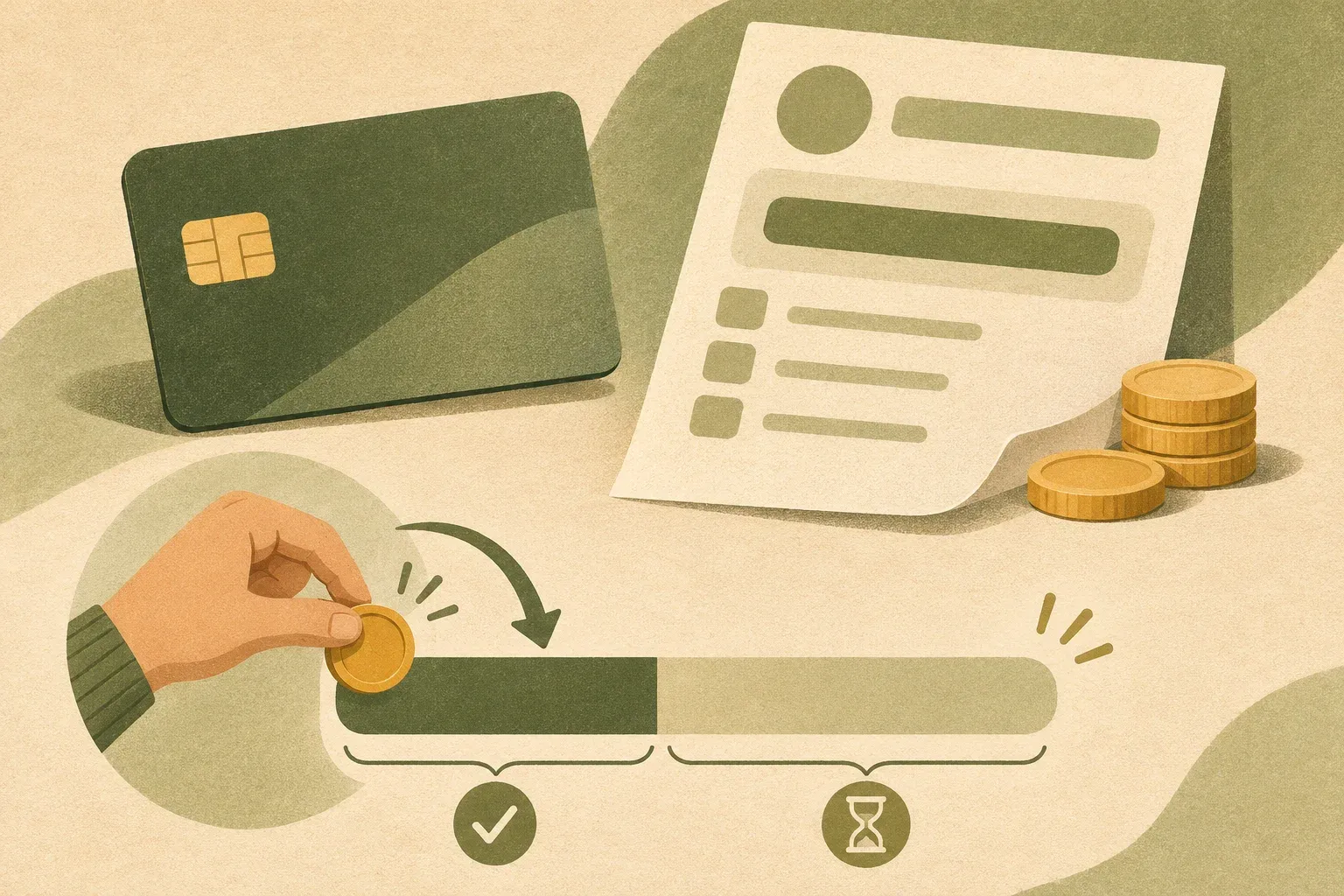
If you do not pay your purchases in full by the due date, interest may cover two periods: the full purchase amount before payment is received, then the outstanding balance afterward. The Bank of Thailand's example uses a 10,000-baht purchase and a 7,000-baht payment. It calculates interest on 10,000 baht before payment and on the remaining 3,000 baht afterward, not on both amounts for the same day.
Do not assume every card starts counting on the purchase date or due date. the BOT explains that the start may be when the issuer pays the merchant, when the purchase is posted to the statement, or on the due date, depending on the card's terms.
Which dates should you check before counting days?
The purchase date is when you used the card. The issuer may post the transaction on a different date. KTC's June 2026 example starts counting from the posting date for partially paid purchases of goods and services. The purchase date is not automatically the starting date.
Also check the statement closing date, the payment due date and the date the issuer actually received your payment. The latter may differ from the day you initiated a transfer. Keep your payment receipt for comparison. With multiple payments, both the balance and the number of days may change each time a payment is received.
Work through a hypothetical 10,000-baht bill
Suppose a single 10,000-baht purchase is posted on October 1, 2026. The statement closes on October 10 and payment is due on October 25. The issuer receives 7,000 baht that day and applies all of it to this purchase. The remaining 3,000 baht is unpaid until the next statement closes on November 10. Assume no previous debt, new purchases, fees or other interest.
For this illustration, assume a fixed annual rate of 16% and a 365-day divisor. The first period runs from posting through the day before payment is received. The second runs from receipt through the next closing date, inclusive. For each period, calculate: balance charged interest × annual rate × number of days ÷ 365
- October 1–24, 24 days: 10,000 × 0.16 × 24 ÷ 365 ≈ 105.21 baht
- October 25–November 10, 17 days: 3,000 × 0.16 × 17 ÷ 365 ≈ 22.36 baht
Add both periods before rounding to get approximately 127.56 baht Add the unpaid 3,000-baht purchase balance for approximately 3,127.56 baht at the assumed closing date. This is not a payoff amount for a later date: interest may continue to accrue. The issuer may also count days and round differently.
If purchases were posted on different dates, count each period separately before adding them up. Do not apply one day count to the whole bill. With different kinds of debt, a payment might not reduce purchases first: KTC's example shows fees and interest being paid before a cash-advance balance in the relevant case.
Does paying the minimum avoid interest?
The minimum is the least the statement asks you to pay this cycle. Even an on-time minimum payment may leave interest on purchases and the outstanding balance. Paying eligible purchases in full and on time helps retain the interest-free period. If you carried a balance from an earlier cycle, ask the issuer whether interest is still accruing and what is needed to regain that period.
Do not estimate the minimum using a percentage you remember; use the amount on your statement. Paying less than the minimum or paying late may trigger consequences under your agreement and other charges. If you expect to struggle, speak to your creditor before the due date about repayment or debt restructuring options.
Why doesn't the interest on your statement match your estimate?
- Compare the full balance, minimum payment, closing date and due date on the statement.
- Separate purchases, installments and cash advances. Check the posting date, rate and start date for each type. the BOT says that cash advances accrue interest from the withdrawal date and may carry an additional fee. The purchase example above does not apply to them.
- Check when the issuer received your payment, how it allocated that payment, any previous interest and fees.
- If the figures still differ, ask the issuer for a breakdown by transaction, balance and day count, plus the payoff amount for the date you plan to pay.
This example helps you question a bill but cannot replace your card's terms. If paying in full will not crowd out essential expenses, paying eligible purchases in full by the due date helps avoid purchase interest. If you cannot pay in full, paying more than the minimum when you can may reduce the balance on which future interest is charged.
Sources
- Bank of Thailand: Credit cards
- Bank of Thailand: Understanding interest
- KTC: Example interest calculations for minimum or partial payments, June 2026 edition
Sources checked November 17, 2026. The example uses assumptions for educational purposes; it is not an actual charge or personalized financial advice. Check the latest terms with your card issuer.