
Claude in Hermes: API, OAuth, and DirectSDK Quotas
Seeing the same Claude model in Hermes doesn't tell you whether a job uses your subscription allowance or incurs API charges. Check the connection route first, especially OAuth versus DirectSDK: they sound similar but draw on different allowances.

Claude in Hermes already exists, but there is not only one path.
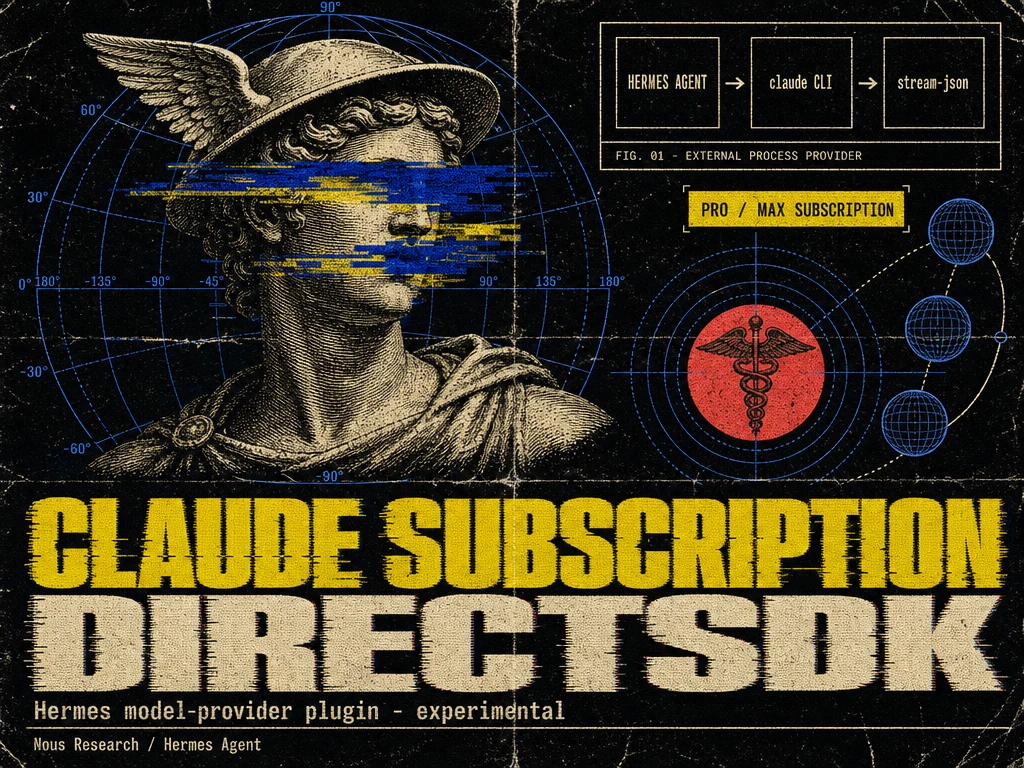
Hermes Agent includes the anthropic provider. It accepts an API key or Anthropic OAuth, and you can also reach Claude through an intermediary. Claude Subscription DirectSDK takes another route: a plugin calls the Claude Code CLI signed in to Pro or Max. The destination model may be the same, but the request path and allowance differ.
Hermes provider documentation says the built-in Anthropic OAuth route requires Max with Extra Usage and draws on that extra credit, not the basic Max allowance. Pro cannot use this route. The List of plug-ins in the catalog says DirectSDK passes each job through Claude Code CLI and uses the signed-in Pro/Max account's Agent SDK allowance.
Compare costs, quotas, and setup for API, OAuth, and DirectSDK
| Path | Identification | What is consumed or billed | Status in Hermes | Who it suits |
|---|---|---|---|---|
| Anthropic API | ANTHROPIC_API_KEY | Usage-based API fees are separate from Claude membership fees. | Built-in Provider | Work that requires a direct API path and clear expense accounting |
| Anthropic OAuth | Sign in with hermes model or use Claude Code credentials | According to Hermes documentation, Claude Max Extra Usage does not consume the base Max quota | Built-in Provider | Max users who have opened and added Extra Usage |
| Claude Subscription DirectSDK | Claude Code CLI at claude auth login | Agent SDK allowance of Pro/Max; Extra Usage also depends on account settings. | Official Nous Research plugin, still experimental | Pro/Max users who accept an experimental plugin's limits |
Here, “Official” means Nous Research maintains the plugin and distributes it through the Hermes catalog; it does not mean Anthropic endorses this particular plugin. The Claude Help Center, updated October 7, 2026, states that the Agent SDK, claude -p and third-party apps could use subscription limits when checked.
There's another detail: the Claude Help Center checked October 29, 2026 says Max and Team include monthly API credits when the key comes from a Console organization linked to the plan. Agent SDK or claude -p signed in under the plan still uses subscription allowance. Don't assume every API key is billed entirely outside the plan. Check the issuing organization, remaining credits, and actual charges separately from Hermes's OAuth route.
Other ways to use Claude with Hermes: identify the paying account and applicable quota
If you already have another provider account, you may be able to reach Claude through it. Seeing Claude in the model list does not mean you'll use Anthropic Pro/Max allowance; billing follows the route you select. Hermes provider documentation documents these connections:
| channel | Account and how to connect | Where is quota consumed or billing charged? | What should I check before using? |
|---|---|---|---|
| OpenRouter | OpenRouter accounts are connected with an API key or OAuth as supported by Hermes. | OpenRouter credits and usage charges | Claude model, price and destination provider selected by route |
| Nous Portal | Nous account login via OAuth hermes model | Nous plan access and limits | Claude version available for account use and remaining usage of the package |
| GitHub Copilot | GitHub account with Copilot permissions, select provider copilot In Hermes | Copilot entitlements and usage accounting by plan | List of models that the account can actually call Including organizational policies and usage limitations. |
| AWS Bedrock | AWS account and permissions to run models using provider bedrock with AWS credentials | AWS account charges based on model and usage model | Region, IAM permissions, model access, and AWS quotas |
Other services exist, and Claude model availability varies by account. GitHub lists support by plan and access route. So seeing Claude in Copilot Chat doesn't establish that Hermes can call that model through Copilot. With OpenRouter, check credits and downstream provider terms before comparing its price with direct API access.
Suppose you have both Claude Pro and Copilot. If you choose copilot in Hermes, the job draws on Copilot even if Claude Pro is signed in locally. Pro allowance does not transfer to that provider. OpenRouter and Bedrock also use their own billing accounts.
Start with an account you already have and check whether it actually offers the Claude model you need. For access to multiple providers, consider OpenRouter or Nous Portal. If you have Copilot, check your entitlement before signing up elsewhere; if your team already uses AWS, compare Bedrock against existing permissions and budgets. For Pro/Max access specifically through Claude Code, review DirectSDK's limitations next.
Open hermes model choose a provider and an available model, then try a short, reversible job. Compare the provider's usage with /usage in Hermes, and check where auxiliary and fallback requests go. Hermes's estimate does not prove the actual bill. Read the data policies of every service on the request path before sending sensitive information.
DirectSDK provides subscription access while Hermes retains control
DirectSDK's name may suggest an additional Python Agent SDK installation, but the Plugin README explains that the implementation calls the official Claude Code executable and communicates over stream-json directly, without separately installing the Python Agent SDK package
Claude Code CLI handles sign-in, session renewal, and account permissions; the plugin has no credentials of its own. It passes Hermes requests to the CLI and returns the results. If subscription access fails, the plugin does not silently switch to an API key. Diagnose this route's sign-in or allowance error, and inspect Hermes fallback separately.
Hermes also controls the agent loop, while Claude Code is the model's gateway.
With either API or DirectSDK, Hermes still manages the conversation, tool calls, approvals, sessions, skills, and context compression. DirectSDK disables Claude Code's native tools and skills and supplies Hermes tools instead, so two agent loops don't compete for control.
Your Hermes memory and skills stay where they are. Switching from Anthropic API to DirectSDK changes model access and allowance accounting, not where Hermes configuration lives. For the agent loop background, read What is Hermes Agent?
Install DirectSDK and verify the path with your account and usage.
The catalog-pinned v0.3.3 manifest specifies Hermes 0.21.4 or later, Python 3.10+, and the official Claude Code CLI. The README gives these steps:
npm install -g @anthropic-ai/claude-code
claude auth login
hermes plugins install claude-subscription-directsdk
hermes model
The last command opens model selection. Choose Claude Subscription DirectSDK (Experimental) and a model available to your account. Try a short job before a gateway, cron task, or long workflow. Reaching the settings screen only shows that the CLI and account were found; it doesn't establish how your model, long-context job, or fallback will behave.
- Verify account: Run this command and confirm that you are signed in to the intended Pro/Max account.
claude auth status - Confirm version: Check the CLI version with this command and compare it with the README’s minimum for the chosen model.
claude --version - Confirm quota: After the trial, check
/usagein Hermes alongside Claude usage. A list-price estimate in logs does not prove an actual charge. - Check Extra Usage: Turn off Extra Usage on your account if you don't want extra charges. Your Anthropic account ultimately determines your access and billing.
Do not copy tokens from a credential file into configuration. The README says DirectSDK does not open, copy, refresh, or print that file; Claude Code owns sign-in. For separate accounts in separate profiles, set claude_config_dir for each profile rather than swapping files by hand.
DirectSDK differs from the Codex subscription path in the location of the connector.
If you've used Codex subscription in Hermes, the difference is practical: OpenAI Codex is built in, supports device-code or browser sign-in, and stores credentials in Hermes's auth store. Hermes can also reuse existing Codex CLI credentials, but the main path doesn't require that CLI. DirectSDK is a separate plugin that calls the locally installed Claude Code CLI for each request.
| Issue | Claude Subscription DirectSDK | OpenAI Codex provider |
|---|---|---|
| Position in Hermes | Official plugin separate | Built-in Provider |
| Required external programs | Requires Claude Code CLI. | The primary path does not require Codex CLI |
| Agent loop owner | Hermes | Hermes |
| Status | Experimental | First-class provider |
| Quota meaning | The plugin documents the Pro/Max Agent SDK allowance | Hermes documentation does not fully detail plan tiers and Codex quota accounting |
Hermes still manages memory, tools, and approvals on both routes; neither Claude Code nor Codex CLI takes over those duties. Compare the model and its provider together. A Claude or GPT label alone won't tell you the request path.
What the DirectSDK tests establish
The README reports tests of tool calls, streaming, resume, denial, steering, and cancellation in a review build. That does not establish parity with the normal provider in every case. Replay and some data passed through Claude Code depend on a versioned interface; check the plugin's current status before updating the CLI or Hermes for important work.
- Long context and cache: The plugin must create a conversation history for Claude Code with each request, so replay and prompt cache behavior is more complicated than a straight API path.
- Upstream errors: Incomplete streams or HTTP errors remain failures; there is no automatic fallback to an API key
- auxiliary and fallback: Hermes also controls these paths. DirectSDK does not automatically switch every compression, vision, subagent, or fallback to subscription. You must check your configuration separately.
- telemetry: The setting
claude_code_telemetryis enabled by default, allowing Claude Code to send usage telemetry and receive feature flags. Disabling it reduces traffic but may narrow the model list. - Plugin security: Official tier means inclusion in Nous Research's catalog. Still check version, commit, and source before updates to important systems.
Choose a Claude connection by account, quota, and cost
If you want agent spending separate from subscription fees and already track an API budget, the built-in Anthropic API route fits. Under the cited Hermes documentation, Anthropic OAuth suits Max users with Extra Usage enabled who accept charges against that extra usage rather than the basic allowance.
If you have Pro or Max and want to try Agent SDK allowance through Claude Code, test DirectSDK with its Experimental status in mind. Check versions and usage yourself. Start with a reversible job and compare stability, allowance consumed, and logs against the same job on the API route.
Before choosing, note whether the account is Pro or Max, whether Extra Usage is enabled, whether the job can tolerate an Experimental plugin, and which providers handle auxiliary and fallback requests. Set the configuration accordingly, then check usage and actual charges on that route rather than relying on the model name.
Sources
- Nous Research: LLM and Model Providers
- Nous Research: Claude Subscription DirectSDK plugin catalog entry
- Nous Research: Claude Subscription DirectSDK README at catalog-pinned commit
- Nous Research: Claude Subscription DirectSDK plugin manifest v0.3.3
- Anthropic: Use the Claude Agent SDK with your Claude plan
- Nous Research: Nous Portal
- OpenRouter: Anthropic models
- OpenRouter: Frequently Asked Questions
- GitHub: Supported AI models in GitHub Copilot
- Anthropic: Access Claude in Amazon Bedrock
Hermes documentation, catalog, plugin 0.3.3 manifest, Nous Portal, OpenRouter, Copilot, and Claude Help Center reviewed October 19, 2026. Plans, quotas, Extra Usage, models, and plugin behavior may change. Check usage and installed-version documentation before costly or important work.