
What is replica-skill? Building a reading-list app prototype
A screenshot can help you copy a layout. But what should an app tell users when saving fails? Replica separates research, design, building, and testing. KrobClick tried some of those stages with a reading-list prototype to see what evidence supports calling the work done.

Replica divides app-building work across 11 Skills
Jakeschincariol/replica-skill is a set of 11 agent Skills spanning app research, architecture, design, backend building, testing, comparison, branding, and launch. It is a workflow, not an AI model or a one-click way to create a sale-ready app.
The source recommends studying functions and user flows, then writing a new implementation. Don't copy the original app's code, logo, images, or text. Check the applicable data rights and source terms for the specific project.
What each stage passes to the next
Start with replica-recon for a screen map, user flows, and feature matrix. Then use replica-architect for architecture, replica-design for colors, spacing, typography, and components, followed by replica-build to implement the plan.
Next, replica-test tests behavior, while replica-diff identifies gaps. Other stages cover backend, entrepreneur, brand, launch, and deploy work as needed. Keep the feature matrix and handoff files; mark a partially implemented feature as partial instead of calling the whole project complete.
Testing the reading-list app's core loop
KrobClick used the public task-list concept from TodoMVC to write a new Thai reading-list prototype. We read and followed the recon, architect, design, build, and test stages in Codex. We did not install the Claude plugin or run Replica's Python scripts.
The prototype adds titles, marks items read, filters and deletes them, and saves them in localStorage. It has no account, sync, title editing, or backend, and it does not attempt every TodoMVC feature. The plan, feature matrix, code, and tests are stored with the article work for reproduction.
What the prototype checks establish
The prototype passed 11 test groups: empty lists, whitespace-only input, HTML-like text, long Thai titles, filtering, deletion, persistence after refresh, keyboard use, corrupt stored data, disabled writes, and page or external-request errors. No overflow was found at 320, 393, or 1440 pixels; axe found no violations in the states checked.
Those results cover only this prototype and the cases run. They do not certify accessibility in every state, multi-tab behavior, or readiness as a service. We did not time a comparable build without the Skills, so we cannot quantify time saved.
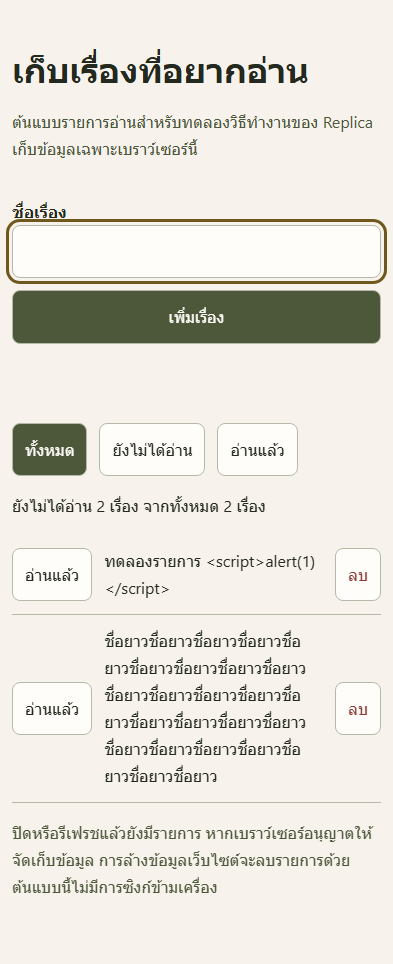
Check that data is saved and failures are reported
Disable localStorage writes: items remain usable in the current page but may disappear on refresh. The prototype must warn users. Showing a saved state without a warning would misrepresent its behavior, however polished the interface looks.
We also entered a title containing HTML-like characters and checked that it appeared as text rather than executing code. These cases say more about working behavior than simply loading the page.
Choose one app flow to test end to end
For your own app, start with one path, such as adding an item that survives a refresh. List what is not implemented, and test empty states, errors, and mobile early. Add accounts or payments only if the task calls for them.
Once that small path passes, consider databases, permissions, and deployment. Read How to verify an Agent's work to inspect evidence rather than accepting a completion report alone.
Sources
- Jakeschincariol/replica-skill: Documentation for the referenced version
- TodoMVC: Task-list reference brief
- Jakeschincariol/replica-skill
Reviewed Replica commit 77c9436fb3d18c3d58169efb8caf4fe906b0dc51 on October 30, 2026. We followed selected instructions in Codex and tested a real prototype. We did not test all 11 Skills or install the Claude plugin.